Critical Update to the BRCGS Food V.9 Standard!
Enhance hygiene and product safety with the key updates to the BRCGS Food V.9 standard. Click now to learn more and ensure compliance!
Global standards implemented in the food industry to maintain the highest levels of consumer health and product safety continue to evolve in line with current requirements and emerging risks. In this context, an update has been published for the BRCGS Food V.9 standard—one of the most widely recognised food safety standards worldwide—which will take hygiene conditions in facilities to the next level.
Behind the Scenes of the Update: The Impact of GFSI v.2024
The GFSI Benchmarking Requirements v.2024 assessments, recently published by the Global Food Safety Initiative (GFSI), demonstrated that industry authorities have raised hygiene and safety expectations to a higher level. As a result of these assessments, the BRCGS committee has integrated changes into the V.9 standard with the aim of reducing product contamination to zero and maximising operational safety standards.
What Has Changed Under Clause 7.4.2 (Protective Clothing)?
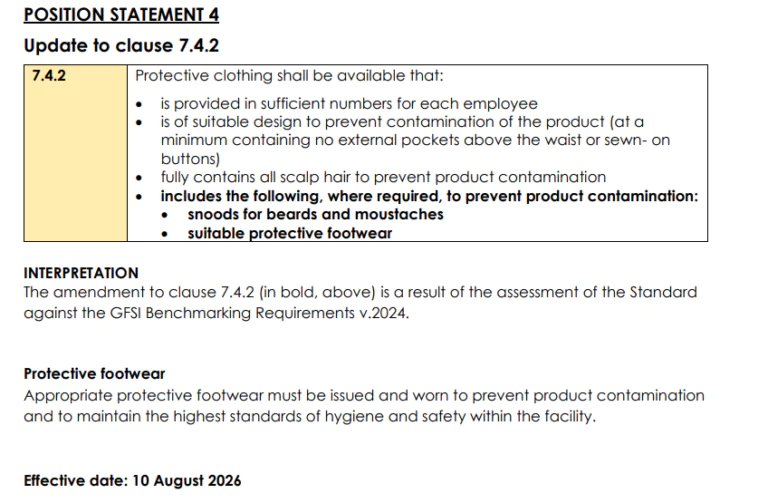
This new amendment to the ‘7.4.2 Protective Clothing’ clause of the BRCGS Food V.9 standard, closely monitored by industry professionals and quality managers, aims to eliminate physical and biological contamination risks directly attributable to staff.
With this update, the following new requirements have been established for production areas:
- To prevent any form of cross-contamination that could jeopardise product safety in production and processing areas, the use of standard-compliant protective footwear is now a strict requirement.
- All staff with beards or moustaches are now required to wear specially designed beard covers (snoods) whilst in production areas to prevent product contamination.
What Lies Ahead for Manufacturers and Facilities?
This new update represents an issue requiring immediate action for all food businesses that are BRCGS-certified or in the process of certification. It is of the utmost importance that businesses swiftly review their personal protective equipment (PPE) procedures, provide their staff with the necessary training on these new rules, and ensure the supply of appropriate equipment.
In today’s world, where food safety is not a choice but a necessity, these new requirements added to the BRCGS Food V.9 standard appear set to further reinforce brands’ commitment to quality for consumers.
Continue to follow the latest developments in quality management systems, standard changes and industry news on our website and social media accounts.
You may be interested in these topics (Newsletter & News)

BRCGS Ambalaj Malzemeleri Versiyon 7 İçin Yeni Pozisyon Bild…
BRCGS Ambalaj Malzemeleri V7 için P708 Pozisyon Bildirimi yayımlandı. Güncel GFSI 2024 beklentilerine uyum sağlayın.…
New Position Statement (P708) for BRCGS Packaging Materials…
P708 Position Statement for BRCGS Packaging Materials V7 published. Ensure compliance with latest GFSI 2024…

Vertical and Horizontal Recommendations for Personal Protect…
With the September 2024 updates, some important changes have been made to the recommendations for…

BSI’den Gıda Sektörüne Önemli Adım: PAS 96:2026 Gıda Savunma…
BSI'dan PAS 96:2026 Gıda Savunması Kılavuzu ile gıda sektöründe kasıtlı tehditlere karşı koruma sağlayın. Detaylı…
Check Our Other Services

BRCGS Food Safety Standards
Certify product quality & safety with BRCGS Food Safety Standard. Boost international recognition and brand…

BRCGS Consumer Products Standard
Ensure the safety of your products in the global market with the BRCGS Consumer Products…

Food and Consumer Product Certification
Ensure a safe supply chain from farm to shelf through food and consumer product certification.…