Advanced sorting technologies including near infrared spectroscopy, Raman spectroscopy, RFID tagging, digital identification systems, and AI powered computer vision are revolutionizing textile recycling. These technologies enable automated material classification and processing at previously impossible scale and accuracy.
These technologies address the sorting bottleneck that has constrained recycling scaling, achieving accuracy exceeding 95% to 98% and processing materials at industrial speeds. Through labor elimination and processing optimization, they provide cost reduction of 25% to 35%, fundamentally transforming textile recycling economics and feasibility.
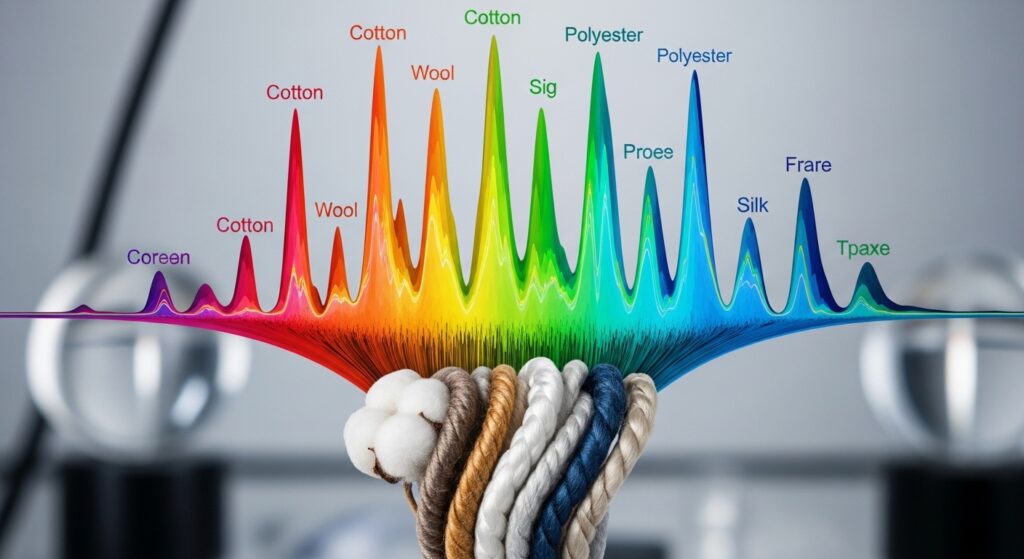
Near infrared (NIR) spectroscopy forms the foundation of automated textile sorting. Every material possesses characteristic spectral signatures across infrared wavelengths. Different fibers including polyester, cotton, nylon, acrylic, wool, silk, and elastane each possess distinct spectral signatures enabling identification.
Beyond fiber identification, advanced systems now detect subtle contamination requiring special handling or disposal. Heavy metals, persistent organic pollutants, microbial contamination, and other hazardous substances can be detected through spectroscopic analysis combined with chemical sensors.
Contemporary textile recycling facilities integrate multiple technologies into coherent systems. A facility that historically required 20 to 30 manual sorters plus additional material handlers can now operate with 4 to 6 workers overseeing automated systems and handling exceptions. This improves both cost efficiency and process reliability significantly.